Chapter 35 — Inheritance Precedence & Predefined Templates for Prisma Access
This chapter covers two related topics: how Panorama resolves conflicting objects across device group hierarchy levels, and the complete set of templates and device groups that Prisma Access creates automatically.
Object Inheritance Precedence
When the same object name is defined at multiple levels of the device group hierarchy, Panorama applies a most-local-wins rule: the definition closest to the managed device takes precedence.
flowchart TD
    SH["Shared<br/>DNS-Server = 8.8.8.8"]
    DG1["Device Group — EMEA<br/>DNS-Server = 10.1.0.53"]
    DG2["Device Group — London<br/>(no override)"]
    FW["Managed Firewall<br/>→ uses 10.1.0.53<br/>(DG-EMEA is closer than Shared)"]

    SH --> DG1 --> DG2 --> FW
Precedence order (highest to lowest):
| Level | Precedence |
|---|---|
| Local firewall definition | Highest — overrides all inherited values |
| Child device group | Overrides parent and Shared |
| Parent device group | Overrides grandparent and Shared |
| Shared | Lowest — applies only when no lower-level definition exists |
Important: Precedence applies to objects (address objects, security profiles, etc.), not to pre-rules. Pre-rules from a parent device group always evaluate before a child device group's pre-rules regardless of inheritance — they are additive, not overridable.
📷 PaloAlto diagram — Object precedence across device group hierarchy
Prisma Access Predefined Templates & Device Groups
At Prisma Access onboarding, Panorama automatically creates one template + template stack pair and one device group per licensed component:
Predefined Templates and Stacks
| Template | Template Stack | Contains |
|---|---|---|
Mobile_User_Template |
Mobile_User_Template_Stack |
GP gateway/portal zone config, routing for MU-SPN |
Remote_Network_Template |
Remote_Network_Template_Stack |
Predefined IKE/IPSec tunnels, IKE gateways, crypto profiles for branch IPSec |
Service_Conn_Template |
Service_Conn_Template_Stack |
IKE/IPSec config for SC-CAN tunnels |
Explicit_Proxy_Template |
Explicit_Proxy_Template_Stack |
Proxy listener zones and interface settings |
The Remote_Network_Template and Service_Conn_Template include vendor-specific predefined IPSec configurations for:
| Vendor / Device | Template Available |
|---|---|
| Aruba SD-WAN (Aruba Branch Gateways — distinct from Silver Peak/EdgeConnect below) | Yes |
| Aryaka SD-WAN | Yes |
| Citrix SD-WAN | Yes |
| Prisma SD-WAN (device) | Yes |
| Nuage Networks SD-WAN | Yes |
| Riverbed SteelConnect SD-WAN | Yes |
| Silver Peak SD-WAN (now HPE Aruba Networking EdgeConnect SD-WAN, post-acquisition rebrand) | Yes |
| Viptela SD-WAN | Yes |
| Generic (unlisted devices) | Yes |
Cisco devices are not in this predefined vendor list — no dedicated Cisco entry currently exists. Separately confirmed: in Strata Cloud Manager, Cisco SD-WAN variants (Catalyst, Meraki) are onboarded via a generic "Other Devices" Branch Device Type option rather than a dedicated Cisco entry; the equivalent on the Panorama side is most likely this table's Generic row, though that specific equivalence wasn't independently confirmed.
These predefined IPSec profiles eliminate the need to manually configure IKE Phase 1 and Phase 2 parameters for common third-party CPE types.
Predefined Device Groups
| Device Group | Parent | Component |
|---|---|---|
Mobile_User_Device_Group |
Shared | GlobalProtect mobile users |
Remote_Network_Device_Group |
Shared | Branch / remote network sites |
Service_Conn_Device_Group |
Shared | Service Connections |
Explicit_Proxy_Device_Group |
Shared | Explicit Proxy (Cloud SWG) |
📷 PaloAlto diagram — Prisma Access predefined templates and device groups
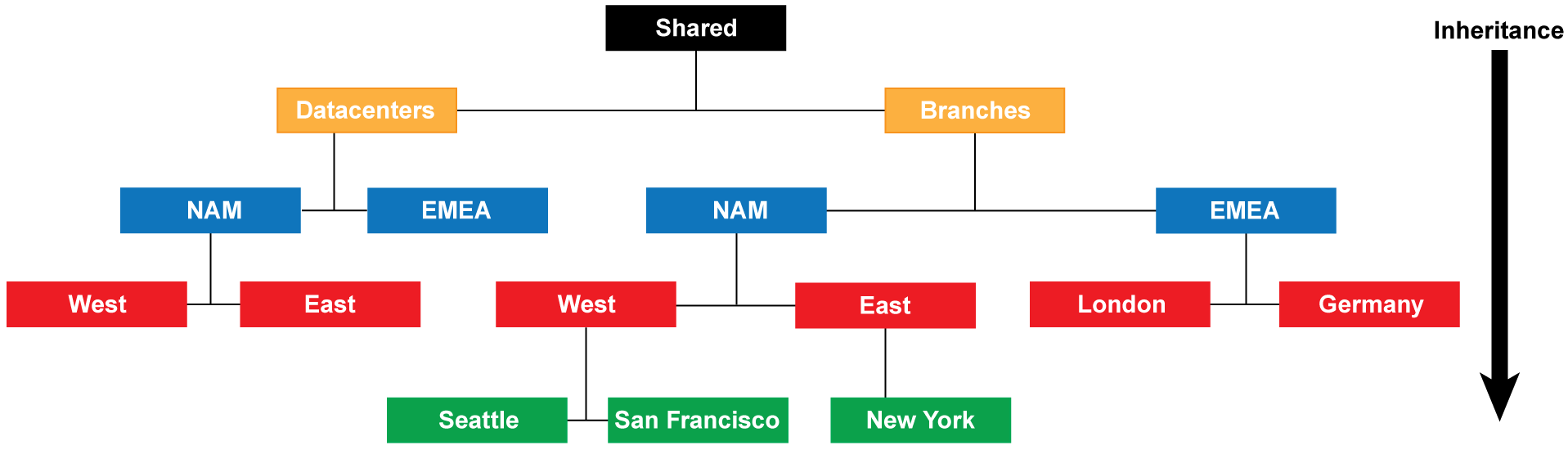
Rules for Working with Predefined Templates and Device Groups
| Action | Allowed? | Notes |
|---|---|---|
| Modify predefined templates | No | Prisma Access manages these — manual edits may be overwritten |
| Delete predefined templates or stacks | No | Required for Prisma Access operation |
| Delete predefined device groups | No | Required for Prisma Access operation |
| Add a custom template to a predefined stack | Yes | Insert below the predefined template to avoid priority conflicts |
| Add security policies to predefined device groups | Yes | Recommended place for Prisma Access-specific security rules |
| Create child device groups under predefined ones | Yes | For regional or functional policy segmentation |
| Add a parent device group above predefined ones | Yes | Allows corporate-wide policies to propagate down to all Prisma Access components |
How This Maps in Strata Cloud Manager
The predefined templates/device groups above map onto SCM's predefined Folder structure — see Chapters 32 and 33 for the full explanation (Folders, Snippets, the confirmed predefined folder names, and the Explicit Proxy-nests-inside-Mobile-Users-Container correction). The most-local-wins, override-not-delete precedence described above is the same mechanic Chapter 34 confirmed directly via SCM's grey/purple/blue inheritance indicators — not repeated here.
Branch Device Type (the one new piece for this chapter): SCM's Service Connection/Remote Network creation flow has a Branch Device Type field (first found during the ch29 SCM-parity session) offering built-in, vendor-specific recommended IKE/IPSec settings — serving exactly the same purpose as this chapter's vendor template table (avoiding manual IKE/IPSec parameter matching for known third-party devices), just delivered as a dropdown during setup rather than as separate predefined template objects.
Vendor table correction (2026-07-09): the vendor table above was found stale during this SCM-parity research and has since been corrected in a follow-up pass, independently re-verified against Palo Alto's "Supported IKE and IPSec Cryptographic Profiles for Common SD-WAN Devices" reference page — the source both Panorama's predefined templates and SCM's Branch Device Type draw from. Confirmed current list: Aruba SD-WAN, Aryaka SD-WAN, Citrix SD-WAN, Prisma SD-WAN, Nuage Networks SD-WAN, Riverbed SteelConnect SD-WAN, Silver Peak SD-WAN, and Viptela SD-WAN — eight vendors, no dedicated Cisco entry. The Silver Peak/Aruba naming question was resolved with sources: Aruba SD-WAN (Aruba Branch Gateways) and Silver Peak SD-WAN (now branded HPE Aruba Networking EdgeConnect SD-WAN, confirmed via Palo Alto's own retitled solution-guide page) are two genuinely distinct products under the same corporate parent, not one product listed twice — both rows are correct as separate entries.
Key Takeaways
- Object precedence: most-local-wins — child device group overrides parent, parent overrides Shared; local firewall definition wins over all
- Pre-rules are additive, not overridable — a parent group's pre-rule always evaluates before a child's
- Prisma Access creates 4 template/stack pairs and 4 device groups at onboarding — do not modify or delete
- Vendor-specific predefined IPSec profiles (Aruba, Aryaka, Citrix, Prisma SD-WAN, Nuage Networks, Riverbed, Silver Peak/HPE Aruba EdgeConnect, Viptela) are included in the Remote Network and Service Connection templates — no dedicated Cisco entry exists
- Extend the predefined setup by adding custom templates to stacks (below the predefined) and custom child device groups beneath the predefined ones
- In Strata Cloud Manager, predefined templates/device groups map onto Folders (see Chapters 32–33) and the same precedence mechanic applies (confirmed in Chapter 34); Branch Device Type is SCM's equivalent of the vendor template table
Previous: Chapter 34 — Device Group Policies & Objects · Next: Chapter 36 — Prisma Access Zones