Chapter 12 — Traffic Flow Scenarios: RN, MU, and SC Permutations
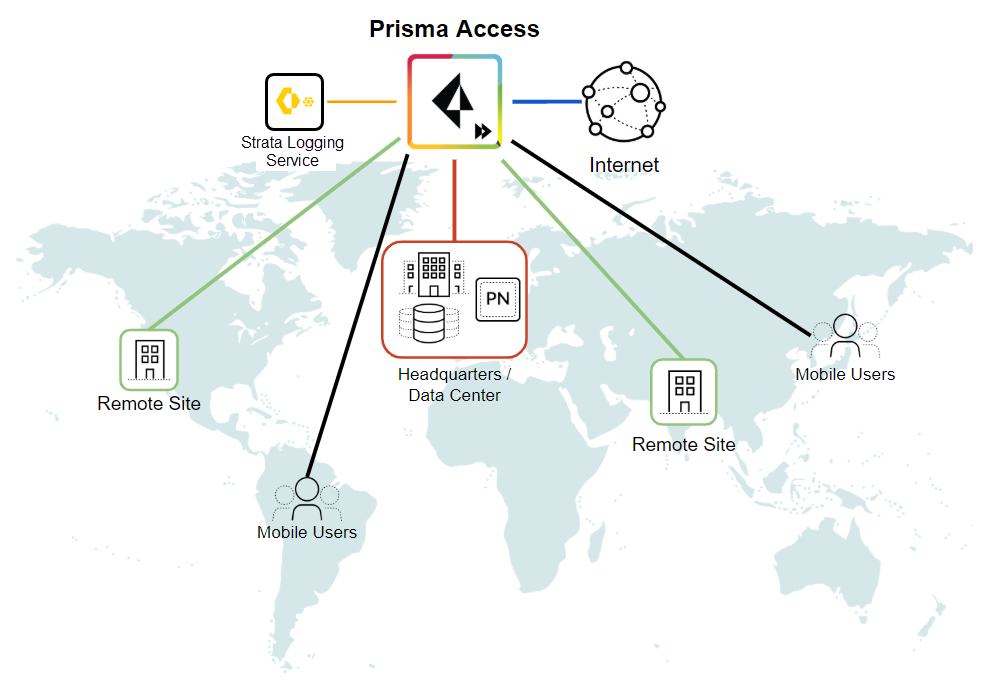
Understanding how traffic flows between the different Prisma Access endpoint types is essential before routing design. This chapter maps all six connectivity permutations — who can reach whom, and what infrastructure is required.
Consistency check, 2026-07-09: this chapter's core claims — full-mesh Remote Networks by default, a Service Connection required for MU↔RN communication and corporate resource access, and RN-SPN/MU-SPN traffic routing through the SC-CAN — are consistent with Chapter 8's Service Connection requirements/redundancy coverage and Chapter 11's resiliency design. Cross-referenced rather than re-verified from scratch.
The Three Endpoint Types
graph TD
    MU["💻 Mobile Users<br/>(MU-SPN)"]
    RN["🏬 Remote Networks<br/>(RN-SPN)"]
    SC["🔗 Service Connection<br/>(SC-CAN → DC/HQ)"]
    INT["🌐 Internet / SaaS"]

    MU <-->|requires SC| RN
    MU --> INT
    MU <-->|via SC-CAN| SC
    RN <-->|full mesh| RN
    RN --> INT
    RN <-->|via SC-CAN| SC
Flow 1 — Remote Network → Internet / SaaS
Path: Branch CPE → RN-SPN → Security inspection → Internet
- No Service Connection required
- All outbound internet traffic from the branch is inspected at the RN-SPN using the full security stack
- The most common traffic flow for branch offices
Flow 2 — Remote Network → Corporate Resources (HQ/DC)
Path: Branch CPE → RN-SPN → SC-CAN → Corporate CPE → Internal app
- Requires a Service Connection (Chapter 8)
- Uses iBGP internally within Prisma Access; uses eBGP to peer with the customer CPE at the DC — verified 2026-07-09, confirmed via direct fetch of Palo Alto's current routing documentation, quoted verbatim (appears twice in the source): "Prisma Access uses iBGP for internal routing and eBGP to peer with customer premises equipment at the data center"
- Traffic is inspected at the RN-SPN before forwarding through the SC
Flow 3 — Mobile User → Internet / SaaS
Path: Endpoint (GlobalProtect) → MU-SPN → Security inspection → Internet
- No Service Connection required
- The user's nearest MU-SPN is selected automatically based on latency
- Full security stack (App-ID, URL filtering, threat prevention, DLP) applied at the MU-SPN
Flow 4 — Mobile User → Corporate Resources (HQ/DC)
Path: Endpoint → MU-SPN → SC-CAN → Corporate CPE → Internal app
- Requires a Service Connection
- MU-SPNs form IPSec tunnels with the nearest Service Connection
- Prisma Access uses iBGP internally and eBGP to peer with CPE at the data centre
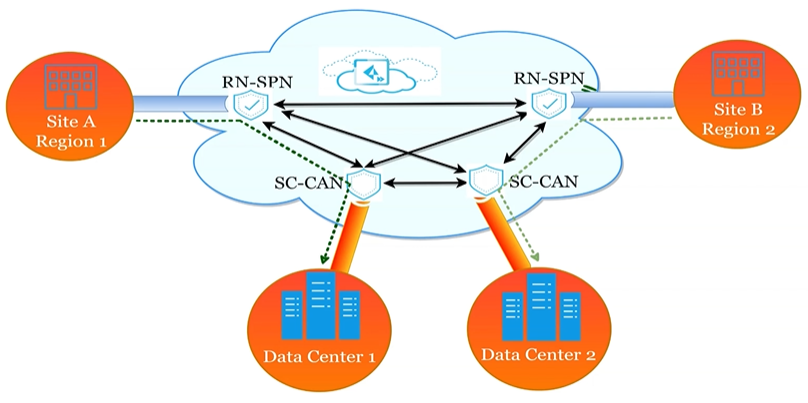
Flow 5 — Remote Network ↔ Remote Network
Path: Branch A → RN-SPN A → Prisma Access backbone → RN-SPN B → Branch B
- Remote Network locations are fully meshed by default — no extra configuration needed
- No Service Connection required for RN-to-RN communication
- Traffic is inspected as it traverses the SPNs
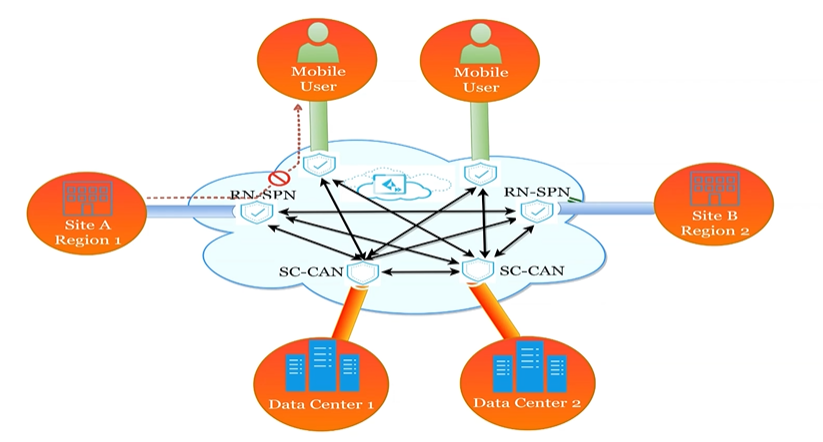
Flow 6 — Mobile User ↔ Remote Network
Path: Endpoint → MU-SPN → SC-CAN → RN-SPN → Branch
- Requires a Service Connection — the SC-CAN acts as the hub for this path
- Mobile users cannot connect to remote networks without a Service Connection, even if no HQ connectivity is needed
- This is the most common reason a Service Connection is deployed even in organisations without on-premises data centres
Summary Table
| Flow | From | To | SC Required? | Path via |
|---|---|---|---|---|
| 1 | Remote Network | Internet/SaaS | No | RN-SPN |
| 2 | Remote Network | Corporate DC | Yes | RN-SPN → SC-CAN → DC |
| 3 | Mobile User | Internet/SaaS | No | MU-SPN |
| 4 | Mobile User | Corporate DC | Yes | MU-SPN → SC-CAN → DC |
| 5 | Remote Network | Remote Network | No | Full mesh via backbone |
| 6 | Mobile User | Remote Network | Yes | MU-SPN → SC-CAN → RN-SPN |
Judgement call, added 2026-07-09: Flows 2 and 4 above assume the standard SC-CAN (IPSec) model. Chapter 8 also covers Colo-Connect, a high-bandwidth alternative path (up to 100 Gbps/region via GCP cloud interconnect) for the same corporate-resource-access flows, coexisting with standard Service Connections. Mentioned here only as a one-line pointer — see Chapter 8 for the full topology; not elaborated further, to keep this chapter's six-flow model clean at its intended level of abstraction.
Key Takeaways
- Remote Networks are fully meshed — no SC needed for branch-to-branch communication
- A Service Connection is required any time Mobile Users need to reach Remote Networks or corporate resources — consistent with ch08 and ch11, confirmed 2026-07-09
- Mobile Users and Remote Networks both use iBGP internally and eBGP at the service connection CPE boundary — verified 2026-07-09 via direct fetch, quoted verbatim from current Palo Alto documentation
- All six flows pass through security inspection at the relevant SPN
- Colo-Connect (see ch08) is a high-bandwidth alternative to the standard SC-CAN path assumed by Flows 2 and 4 — mentioned as a pointer only, not elaborated here
Previous: Chapter 11 — Resiliency & Redundancy Design · Next: Chapter 13 — Default Routing (Cold Potato)