Chapter 11 — Resiliency & Redundancy Design Considerations
Prisma Access provides substantial built-in resilience at the platform level — you do not manage the cloud infrastructure. However, the redundancy of the connections into Prisma Access is your design responsibility. This chapter covers what is automatic, and what requires deliberate design.
Built-In Platform Resilience
These are handled automatically by PaloAlto Networks — no customer configuration required:
- Multi-AZ PoPs — each Prisma Access point of presence spans multiple cloud availability zones; a zone failure triggers automatic re-connection to another zone in the same PoP
- Automatic connection re-establishment — if an MU-SPN or RN-SPN fails, clients and branches reconnect to an alternative node without manual intervention
- Security content updates — threat signatures, URL categories, and WildFire updates are applied without service interruption
Service Connection Redundancy
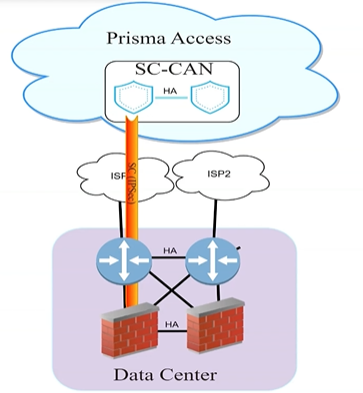
Service Connections are the component most likely to require deliberate redundancy design — they are the customer-managed IPSec tunnels, and their uptime depends on your CPE and ISP as well as the Prisma Access platform.
Active + Backup Design
graph TD
    PA["☁️ Prisma Access"]
    SC_A["SC Active<br/>BGP MED = 0"]
    SC_B["SC Backup<br/>BGP MED = 500"]
    CPE_A["CPE / Firewall A<br/>(primary ISP)"]
    CPE_B["CPE / Firewall B<br/>(secondary ISP)"]
    DC["🏢 Data Centre"]

    PA --> SC_A --> CPE_A --> DC
PA --> SC_B --> CPE_B --> DC- Prisma Access uses BGP MED values to distinguish roles: active connections receive MED 0, backup connections receive MED 500
- If the active SC fails (ISP outage, CPE failure), BGP reconverges and traffic switches to the backup SC automatically
Cross-reference, 2026-07-09: Chapter 31 rigorously confirmed this exact mechanism via direct fetch, including a nuance not spelled out here — this is Prisma Access's own outbound MED advertisement to the CPE; it does not honor inbound MED the CPE advertises. See Chapter 31 for the full detail; not re-derived here.
Multi-Cloud Redundancy
Distribute active and backup SCs across different cloud providers (AWS, GCP) and/or different geographic regions:
- Protects against cloud provider regional outages
- Both SCs can remain within the same country (data sovereignty compliance) while using different providers
- When backup SCs are configured, they load-share traffic if all active connections fail
Cross-reference, 2026-07-09: Chapter 8 covers this topology in fuller detail, including Colo-Connect — a related, high-bandwidth alternative to IPSec-based Service Connections (up to 100 Gbps/region via GCP cloud interconnect) that coexists with the topologies described here. See Chapter 8 rather than repeating that detail.
📷 PaloAlto diagram — Service Connection multi-cloud redundancy topology
Remote Network Redundancy
Primary + Secondary Location
Site-based remote networks (PA 6.0+) support specifying a Primary and Secondary compute location for each site:
- Primary location handles normal traffic
- If the primary compute location becomes unavailable, traffic fails over to the secondary location automatically
- Choose locations in different geographic regions for maximum resilience
⚠️ Flagged, 2026-07-09 — this feature's availability may depend on an unresolved documentation ambiguity. This section is explicitly scoped to "Site-based remote networks (PA 6.0+)." Chapter 38 found that Palo Alto's own current documentation genuinely contradicts itself on whether Site-Based is the default bandwidth model for new deployments, or whether Aggregate remains available for all new deployments. If your deployment ends up on the Aggregate model, this specific Primary/Secondary redundancy feature's availability isn't guaranteed by what's confirmed in this chapter — see Chapter 38 for the full ambiguity rather than re-litigated here, and confirm directly in your own tenant before planning around this feature.
IPSec Tunnel Redundancy
For each remote site, two IPSec tunnels can be configured:
| Mode | Behaviour |
|---|---|
| Active/Active | Both tunnels carry traffic simultaneously; each carries ~50% of load; ECMP load balancing |
| Active/Passive | Primary tunnel carries all traffic; secondary is standby only; failover on primary loss |
Cross-reference and light verification, 2026-07-09: Chapter 41 did a deep investigation into ECMP — full requirements, scale limits, and a corrected conditional scale ceiling (previously miscast as a flat 62-site cap). The "~50% each" framing here is a reasonable simplification for a 2-tunnel scenario and not actively misleading against ch41's fuller picture — ECMP load-balances per-flow across equal-cost paths, which tends toward roughly even distribution over many flows without guaranteeing an exact 50/50 split. One thing worth knowing before choosing Active/Active, not previously mentioned here: ch41 confirmed QoS and static routes are not supported once ECMP is enabled — a site must route entirely via BGP. See Chapter 41 for the complete requirements and scale-limit detail; not repeated here.
graph TD
    CPE["🏬 Branch CPE"]
    T1["IPSec Tunnel 1<br/>(Primary / Active)"]
    T2["IPSec Tunnel 2<br/>(Secondary)"]
    SPN["RN-SPN<br/>(Prisma Access)"]

    CPE --> T1 --> SPN
CPE --> T2 --> SPN- Active/Active is preferred when maximum throughput and seamless failover are required
- Active/Passive is simpler to configure and sufficient for most branch deployments
Mobile User Redundancy
Automatic Gateway Failover
GlobalProtect clients continuously measure gateway latency. If a gateway becomes unavailable: - The client automatically reconnects to the next available gateway - No user intervention required; reconnection is transparent
Regional Redundancy
Investigated 2026-07-09, genuinely new ground for this project — treated as a first-time review, not a light confirmation. This concept could not be independently confirmed as a currently-documented, standalone feature via direct fetch, despite repeated attempts. This chapter's original source link (a legacy, versioned
prisma-access-panorama-adminURL — a pattern that has been superseded across most of this manual's other sources, and has been removed from this section rather than repeated) redirected to a generic "Prisma Access Overview" page on every direct-fetch attempt, rather than surfacing dedicated Mobile User Regional Redundancy content. WebSearch results describe a plausible, internally-consistent mechanism (redundant paths between the Mobile User dataplane and Service Connections in different compute locations, achieved by onboarding 2+ Service Connections in different compute locations) — but this could not be corroborated against a live, current primary-source page, so it isn't presented here with the same confidence as the rest of this chapter.What's more likely, based on the pattern found: this content may have been consolidated into the Service Connection Multi-Cloud/Regional Redundancy documentation already covered above in this chapter and in full in Chapter 8, rather than remaining a distinct, separately-documented feature — the underlying mechanism described (multiple Service Connections across compute locations providing mobile users a resilient path to corporate resources) is essentially the same thing that section already describes. Don't treat this as a confirmed, separate configuration step from Multi-Cloud Redundancy above without verifying directly in your own tenant.
Mobile user regional redundancy — as this manual previously described it — provides redundant network paths between the Mobile User dataplane and Service Connections at different compute locations:
- Believed to be configured at the global mobile user level (not per-user) — not independently re-confirmed in this pass
- Intended to ensure corporate resource access continues if a Service Connection's compute location becomes unavailable
- Traffic would reroute to an SC in the alternate region — functionally the same outcome the Multi-Cloud Redundancy section above already describes from the Service Connection side
If you need this specific capability, verify directly in your Prisma Access tenant (under Mobile User / GlobalProtect settings) rather than relying on this section, whose source link could not be confirmed current.
Redundancy Design Summary
| Component | Built-In (Automatic) | Customer-Designed |
|---|---|---|
| Platform PoPs | Multi-AZ, auto-reconnect | — |
| Service Connections | BGP reconvergence | Active/backup SC placement, multi-cloud |
| Remote Networks | — | Dual tunnels (A/A or A/P), secondary location |
| Mobile Users | Gateway failover | Regional redundancy for SC access — unconfirmed as a standalone feature, 2026-07-09; likely overlaps with Service Connection Multi-Cloud Redundancy above |
Key Takeaways
- The Prisma Access platform itself is multi-AZ and self-healing — your design effort focuses on the connection layer
- Service Connections use BGP MED to distinguish active (MED 0) from backup (MED 500) — this is Prisma Access's own outbound advertisement (see ch31) — always deploy at least one backup SC in a different cloud provider (see ch08 for the full topology, including Colo-Connect)
- Remote network dual-tunnel Active/Active provides throughput and seamless failover, but disables QoS and static routes (see ch41 for full ECMP requirements and scale limits); Active/Passive is the simpler alternative
- Flagged 2026-07-09 — the Primary/Secondary compute location redundancy feature is scoped to Site-Based remote networks; its availability may depend on Chapter 38's unresolved Aggregate-vs-Site-Based documentation ambiguity
- Mobile user gateway failover is automatic — regional redundancy as a standalone Mobile User feature could not be independently confirmed 2026-07-09 (stale source link, no successful direct-fetch confirmation); it likely overlaps with Service Connection Multi-Cloud Redundancy rather than being a distinct configuration step — verify directly in your tenant
- For maximum resilience: multi-cloud SCs + dual-tunnel RN, and confirm the mobile-user-side redundancy mechanism directly in your tenant
Previous: Chapter 10 — Mobile User Deployment Planning · Next: Chapter 12 — Traffic Flow Scenarios