Chapter 14 — Hot Potato Routing
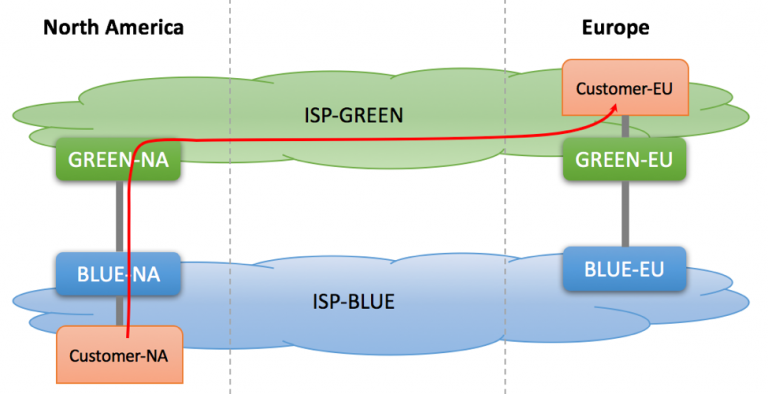
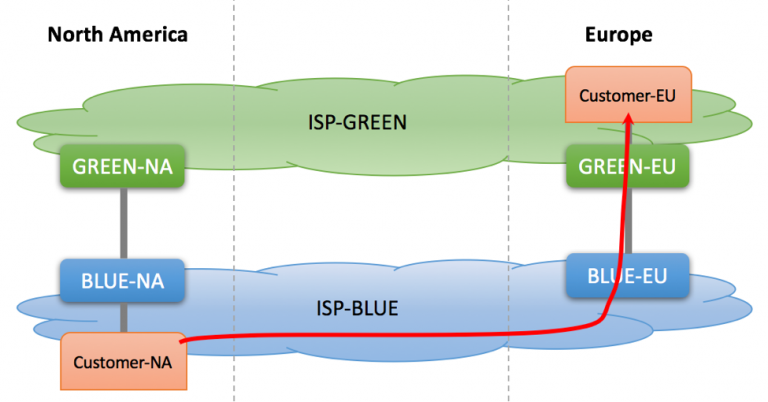
Hot potato routing is an alternative to default routing where Prisma Access egresses traffic to the customer's network as quickly as possible — at the first available exit point — instead of holding it in the Prisma Access fabric to find the optimal SC. It achieves this through AS-PATH prepending to influence BGP path selection at the CPE.
The Core Principle
flowchart TD
    A["User / Branch<br/>sends traffic"]
    B["MU-SPN or RN-SPN<br/>(nearest to user)"]
    C["Nearest SC-CAN<br/>egresses traffic<br/>AS-PATH = shortest"]
    D["Far SC-CAN<br/>discouraged by<br/>AS-PATH prepends"]
    E["Customer CPE<br/>prefers shortest AS-PATH"]

    A --> B
    B --> C
    B -->|longer AS-PATH| D
    C --> E
Traffic exits through the SC closest to the source (fewest AS-PATH prepends) — the CPE's BGP best-path selection then naturally prefers the shortest AS-PATH for return traffic, making the path symmetric.
AS-PATH Prepend Values
Prisma Access applies different numbers of prepends based on the Service Connection's role and BGP peer relationship:
| SC Role | Same BGP Peer IP | Different BGP Peer IP |
|---|---|---|
| Primary SC | 0 prepends | 1 prepend |
| Backup SC (designated) | 3 prepends | 4 prepends |
| Other SCs | 6 prepends | 7 prepends |
- 0 prepends = shortest AS-PATH = most preferred by CPE
- 6–7 prepends = strongly discouraged — only used if primary and backup are both unavailable
This creates a clear preference hierarchy: primary SC → backup SC → all other SCs.
Verified 2026-07-09 — all six prepend counts confirmed still current via direct fetch of Palo Alto's current routing documentation: Primary 0/1, Backup 3/4, Other 6/7 (same/different BGP peer IP respectively) — no changes needed.
Primary and Backup SC Designation
When configuring a Remote Network or Service Connection in hot potato mode, you designate one SC as primary and optionally one as backup:
graph TD
    PA["☁️ Prisma Access"]
    SC_P["SC Primary<br/>0 prepends<br/>(preferred)"]
    SC_B["SC Backup<br/>3 prepends<br/>(standby)"]
    SC_O["Other SCs<br/>6 prepends<br/>(last resort)"]
    DC["🏢 DC / CPE"]

    PA --> SC_P --> DC
    PA --> SC_B --> DC
PA --> SC_O --> DC- Normal traffic: exits via the primary SC (AS-PATH = shortest)
- Primary fails: CPE now prefers the backup SC (3 prepends become best available)
- All designated SCs fail: remaining SCs activate with 6-prepend AS-PATH
Why Hot Potato Solves Route Summarisation
In default routing, if the CPE summarises routes (e.g. advertises 10.0.0.0/8 instead of individual /24s), Prisma Access loses the granularity to determine which SC the return traffic should use — causing asymmetry.
Hot potato avoids this problem because: - The exit decision is made outbound based on AS-PATH, not on the CPE-advertised prefix - The CPE's return path follows the same BGP preference (shortest AS-PATH) automatically - Route summarisation does not affect the AS-PATH-driven selection
ℹ️ Investigated 2026-07-09 — priority item, resolved as "claim not overturned," not confirmed as fact either. Research surfaced during Chapter 13's review suggested a directly conflicting claim: that enabling route summarization while using Hot Potato causes Prisma Access to stop AS-PATH prepending, potentially reintroducing asymmetric routing. This was investigated rigorously — multiple direct, targeted fetches of the specific current Palo Alto page the claim was attributed to (including an exact-phrase search for "no longer prepends" combined with "hot potato" and "route summarization") found no such statement anywhere on that page. This matches a pattern seen repeatedly elsewhere in this project this session: a specific, plausible-sounding claim that traces only to aggregated search-engine summaries, not to any verifiable primary-source text. The claim is not applied as a correction here. At the same time, this chapter's own "unaffected by route summarization" framing above is architectural reasoning (AS-PATH prepending is an outbound Prisma-Access-side mechanism, independent of how the CPE aggregates its own inbound-learned routes) rather than a direct docs quote either — it wasn't found explicitly stated as such in the fetched source. Treat it as a reasoned, not contradicted, claim — not a verbatim-confirmed one. If you're relying on this behavior for a production design, verify directly with Palo Alto or in your own tenant rather than trusting either framing at face value.
Default vs Hot Potato — Decision Guide
| Scenario | Recommended Mode |
|---|---|
| Single SC | Either (default is simpler) |
| Multiple SCs, independent DCs, no summarisation | Default |
| Multiple SCs with backbone between DCs | Hot Potato (avoid asymmetric issues) |
| CPE summarises routes on SC advertisements | Hot Potato required |
| Deterministic symmetric routing across multiple DCs | Hot Potato |
| Want CPE to fully control routing | Default |
Key Takeaways
- Hot potato egresses traffic at the nearest SC by using AS-PATH prepending to influence CPE BGP preference
- Primary SC = 0 prepends, backup SC = 3 prepends, other SCs = 6 prepends (+ 1 more for different BGP peer IPs) — confirmed still current 2026-07-09
- Symmetric return routing is achieved because the CPE naturally prefers the shortest AS-PATH
- Required when the CPE uses route summarisation — default routing breaks under summarisation
- Investigated 2026-07-09 — a claim that Hot Potato itself becomes compromised by route summarization (stops AS-PATH prepending) could not be verified against its cited primary source despite rigorous, targeted attempts; not applied as a correction, but this chapter's own "unaffected" claim isn't a directly-quoted fact either — treat both with appropriate caution
- Designate a backup SC to ensure automatic failover with a 3-prepend preference
Previous: Chapter 13 — Default Routing (Cold Potato) · Next: Chapter 15 — Prisma SD-WAN Overview & Architecture