Chapter 20 — ZTNA Connector Overview & Components
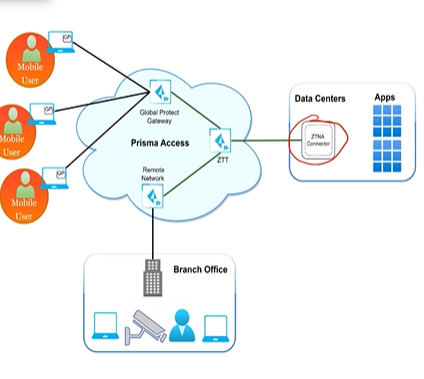
ZTNA Connector is a software-based private application access solution included in Prisma Access. It gives mobile users and branch users access to private apps through an automated outbound IPSec tunnel — with no need to configure IPSec or IKE settings manually, and without exposing any ingress firewall rules.
What Problem Does It Solve?
Traditional private-app access via a Service Connection requires: - A dedicated IPSec tunnel from Prisma Access to the corporate DC - Full network-layer reachability from the SC to all app servers - Manual BGP peering and routing configuration
ZTNA Connector replaces that with: - A lightweight VM deployed inside the data centre or cloud, next to the apps - The Connector initiates all tunnels outbound — no inbound firewall rules needed - App access is granular: only the apps you explicitly onboard become reachable - Supports overlapped private networks (same RFC 1918 address space across DCs) without NAT
graph TD
    USER["💻 Mobile User<br/>or Branch"]
    PA["☁️ Prisma Access<br/>(ZTT — ZTNA Tunnel Terminator)"]
    CONN["ZTNA Connector VM<br/>(outbound tunnel)"]
    APP["🖥️ Private App<br/>(DC / Cloud)"]

    USER -->|GlobalProtect / RN| PA
    PA <-->|automated IPSec| CONN
CONN --> APP- The Connector discovers the nearest Prisma Access node (ZTT) automatically
- Access is enforced by standard Prisma Access security policies: User-ID, App-ID, Device-ID
The Three Components
1 — Connectors
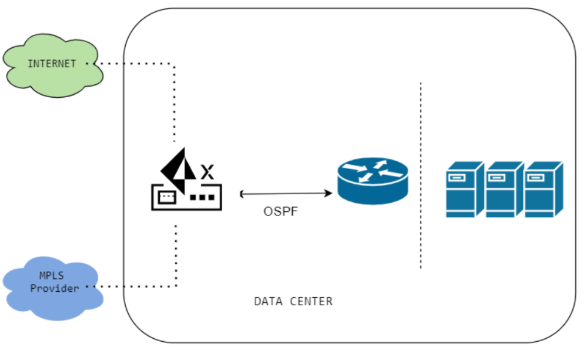
A Connector is a virtual machine deployed in the data centre, cloud, or on-premises virtualisation platform where private apps reside.
- Automates IPSec tunnel establishment to Prisma Access — no manual IKE/IPSec config
- Discovers the nearest Prisma Access location automatically
- Supports one-arm or two-arm network topologies
- Can be deployed on: AWS, GCP, Azure, Oracle Cloud, VMware ESXi, KVM, Hyper-V
Bandwidth capacity:
| Unit | Bandwidth |
|---|---|
| Single Connector | up to 2 Gbps |
| Connector Group (4 Connectors) | up to 6 Gbps |
2 — Connector Groups
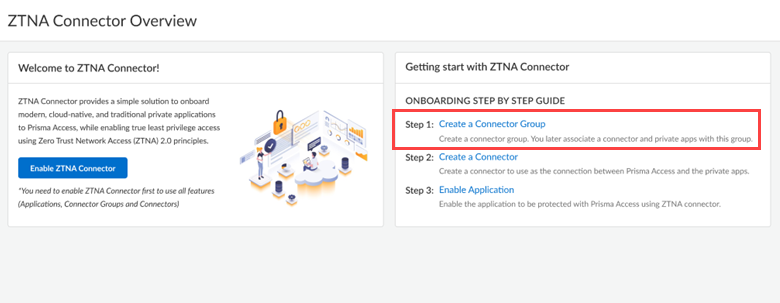
A Connector Group is a logical grouping of up to 4 Connectors associated with a set of application targets.
graph TD
    PA["☁️ Prisma Access"]
    CG["Connector Group<br/>(up to 4 Connectors)"]
    C1["Connector 1"]
    C2["Connector 2"]
    C3["Connector 3"]
    APPS["🖥️ Private Apps<br/>(Targets)"]

    PA <-->|IPSec tunnels| CG
    CG --> C1
    CG --> C2
    CG --> C3
C1 & C2 & C3 --> APPS- Provides tunnel redundancy — if one Connector fails, others continue serving traffic
- Provides bandwidth aggregation — traffic load-balanced across Connectors in the group
- Each Connector Group has its own Key and Secret used to authenticate Connector VMs at deployment time
- Targets are associated with Connector Groups, not individual Connectors
Scale limits:
| Resource | Limit |
|---|---|
| Connectors per group | 4 |
| Connectors per tenant (base) | 10 |
| Connectors per tenant (Private App add-on) | 200 |
| Applications per group | 1,000 |
| Concurrent sessions per Connector | 100,000 |
| Concurrent sessions per group | 400,000 |
3 — Targets
Targets are the private applications that ZTNA Connector makes accessible through Prisma Access.
Three target types are supported:
| Target Type | Example | Use Case |
|---|---|---|
| Wildcard | *.example.com |
Auto-discovers all apps matching the pattern |
| FQDN | app1.example.com |
Single application with load-balancing across resolved IPs |
| IP Subnet | 10.10.1.0/24 |
DC subnets; maximum 16 subnets per rule |
📷 PaloAlto diagram — ZTNA Connector targets and connector groups
Licensing
| Tier | Connectors | FQDNs | IP Subnets |
|---|---|---|---|
| Base Prisma Access | 10 | 20,000 | 1,024 |
| Private App add-on | 200 | 20,000 | 1,024 |
Minimum required version: Prisma Access 5.0
Key Takeaways
- ZTNA Connector gives granular private-app access without full-network Service Connection tunnels
- Three components: Connectors (VMs), Connector Groups (logical redundancy/bandwidth units), Targets (app definitions)
- Connectors initiate outbound IPSec — no inbound firewall rules required
- Single Connector: 2 Gbps; Connector Group (4 Connectors): 6 Gbps
- Targets defined as wildcard FQDN, exact FQDN, or IP subnet
Previous: Chapter 19 — Data Center Scaling Design · Next: Chapter 21 — ZTNA Use Cases & Packet Flow