Chapter 19 — Data Center Scaling Design
As the number of branch sites grows, the DC must be designed to scale — both in terms of ION device capacity and logical topology. This chapter covers DC ION placement, cluster architecture, branch assignment, and how to scale across multiple DC clusters.
DC ION Placement Options
Off-Path (Recommended Default)
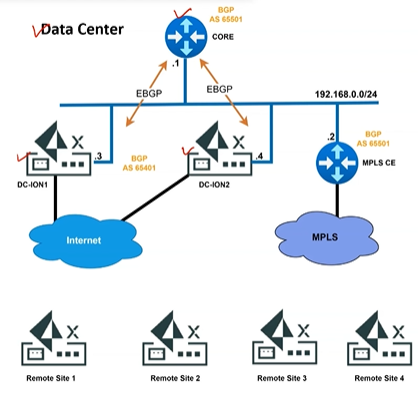
The ION device connects to the DC core router and WAN edge router as a side attachment — it is not inline between the routers and does not affect existing traffic flows.
graph TD
    WAN_E["WAN Edge Router"]
    ION_DC["ION Device<br/>(DC — off-path)"]
    CORE["DC Core Router"]
    LAN["DC LAN / App Servers"]
    BRANCH["SD-WAN Fabric<br/>(branch VPN tunnels)"]

    WAN_E <--> CORE <--> LAN
    ION_DC <-->|BGP peer| CORE
    ION_DC <-->|BGP peer| WAN_E
BRANCH -->|VPN terminates| ION_DC- Existing DC routing is not disrupted — the ION is an additional BGP peer
- The ION only attracts traffic for branches where a VPN tunnel is active
- Simplest integration path for environments with mature DC routing
Inline (L3 DC Mode)
The ION device is placed between the private WAN routers and the DC core/LAN. Supported since ION software version 6.4.1 (requires OSPF on LAN in DC mode).
- Provides more granular traffic steering and visibility
- Used when the DC lacks a core router that can peer with the ION via BGP
- More disruptive to deploy in existing environments
DC BGP Peering
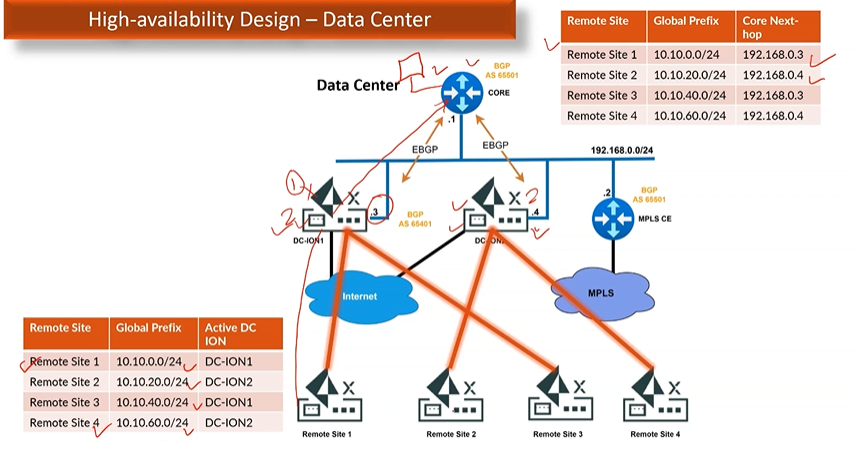
DC ION devices use three BGP peer types within a single routing domain:
| Peer Type | Connects To | Purpose |
|---|---|---|
| Edge peer | WAN edge router | Exchanges WAN prefixes and branch routes via SD-WAN fabric |
| Core peer | DC core router | Distributes branch/SD-WAN routes into the DC LAN |
| Classic peer | Any L3 device | Traditional BGP for complex topologies requiring full control |
The ION handles route-map generation, update filtering, and redistribution automatically — manual route-map config is not required for standard deployments.
DC Cluster Architecture
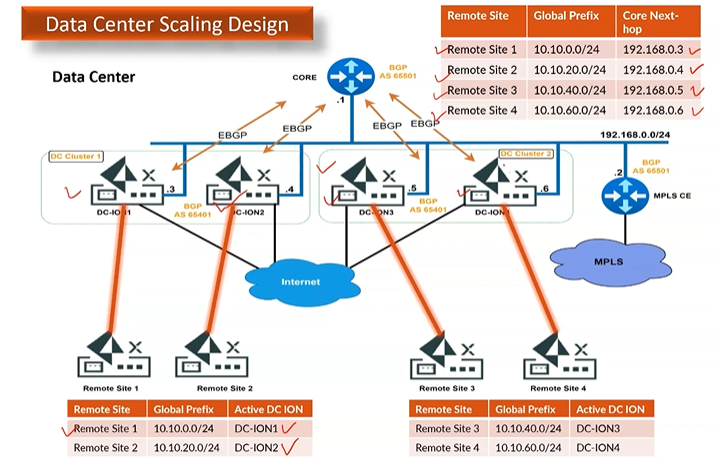
A DC cluster is a logical group that associates a set of branch sites with a specific DC site (and its ION devices). All branches in a cluster establish VPN tunnels to the DC ION devices in that cluster.
graph TD
    DC1["🏢 DC — East<br/>Cluster A"]
    DC2["🏢 DC — West<br/>Cluster B"]
    B1["Branch 1<br/>(mapped to Cluster A)"]
    B2["Branch 2<br/>(mapped to Cluster A)"]
    B3["Branch 3<br/>(mapped to Cluster B)"]
    B4["Branch 4<br/>(mapped to Cluster B)"]

    B1 -->|VPN| DC1
    B2 -->|VPN| DC1
    B3 -->|VPN| DC2
    B4 -->|VPN| DC2
Cluster rules: - Each DC site gets a default cluster automatically on creation - New branch sites are automatically mapped to the default cluster - A branch can only belong to one cluster at a time - Branches can be moved between clusters via Manage branches on cluster
Scaling Across Multiple Clusters
As the number of branches grows beyond a single DC ION pair's capacity, add clusters:
| Scaling Action | How |
|---|---|
| Add a second DC ION pair | Add a new cluster to the same DC site — branches assigned to new cluster connect to new ION pair |
| Split load across DCs | Create clusters at different DC sites — assign branches geographically or by latency |
| Move branches between clusters | Use "Manage branches on cluster" — affects which DC ION the branch establishes VPN to |
| Monitor cluster capacity | Set soft limits; "Hub Cluster Branch Count Limit Exceeded" alarm fires when exceeded |
Scaling design principle: Each cluster represents a DC ION pair's VPN capacity. Size clusters so each ION pair handles the number of branches it can sustain at target bandwidth — then add clusters as branch count grows.
Multi-DC Cluster Design
graph TD
    CTRL["☁️ SD-WAN Controller"]
    DC_E["DC East<br/>Cluster A<br/>Branches: EMEA"]
    DC_W["DC West<br/>Cluster B<br/>Branches: Americas"]
    DC_AP["DC Asia-Pacific<br/>Cluster C<br/>Branches: APAC"]
    BB["Private WAN<br/>Backbone<br/>(DC interconnect)"]

    CTRL -.->|manages all| DC_E
    CTRL -.->|manages all| DC_W
    CTRL -.->|manages all| DC_AP
DC_E <--> BB <--> DC_W <--> BB <--> DC_AP- Assign branches to the geographically nearest DC cluster for lowest latency
- DC backbone connects clusters for DC-to-DC traffic and route exchange
- Each cluster managed centrally through a single Strata Cloud Manager instance — this holds within one organisation's tenant; MSPs or enterprises with separate legal/billing tenants still see each tenant's SD-WAN fabric managed as its own distinct SCM instance rather than merged into one view (the same multi-tenancy scoping distinction covered for Prisma Access in Chapter 6)
Key Takeaways
- Off-path ION placement is the recommended default — non-disruptive BGP peering with existing DC infrastructure
- Inline placement available since ION software 6.4.1 for environments needing in-path steering
- DC BGP uses three peer types: edge, core, and classic — ION handles route-map generation automatically
- Clusters logically group branches to a DC ION pair; branches belong to exactly one cluster
- Scale by adding clusters (more ION pairs) at the same or additional DC sites, then re-assigning branches
Previous: Chapter 18 — SD-WAN Design Considerations · Next: Chapter 20 — ZTNA Connector Overview