Chapter 17 — ION Device Family & High-Availability Design
ION devices are the forwarding elements at every Prisma SD-WAN site. This chapter covers the hardware and virtual form factors available, their deployment contexts, operating modes, and how branch HA works.
ION Device Family
Hardware Appliances
Corrected 2026-07-09 — a larger correction than a single-model footnote suggested. This table previously listed all models in each row as if uniformly current. Confirmed directly against Palo Alto's official Hardware End-of-Life Dates page: five of the seven rows below include at least one end-of-sale model — not just ION 3000 and ION 9000. Restructured with an explicit Status column so a reader planning a new deployment doesn't accidentally spec a discontinued model:
| Model | Status | Typical Deployment | Current Replacement |
|---|---|---|---|
| ION 1000 | End-of-sale (Feb 2024) | Small branch — low-throughput | ION 1200 |
| ION 1200 / 1200-S | Current — end-of-sale effective Sept 1, 2026 (imminent) | Small branch — optional 4G/5G cellular variants | ION 1200-C5G-WW / 1200-S-C5G-WW |
| ION 2000 | End-of-sale (Feb 2024) | Medium branch | ION 1200-S |
| ION 3000 | End-of-sale (Mar 2024) | Large branch or small DC | ION 3200 |
| ION 3200 / 3200H | Current | Large branch or small DC | — |
| ION 5200 | Current | Large branch / regional hub | — |
| ION 7000 | End-of-sale (Feb 2022 — longest-EOS model in this table) | Data centre / high-throughput | No replacement listed |
| ION 9000 | End-of-sale (Jun 2024) | Large data centre / carrier-grade | ION 9200 |
| ION 9200 | Current | Large data centre / carrier-grade | — |
⚠️ For new deployments, spec only the "Current" rows (1200/1200-S for now, 3200/3200H, 5200, 9200) — everything marked end-of-sale can no longer be newly ordered, though existing deployments remain supported through their listed End-of-Life dates. ION 1200/1200-S specifically are current today but scheduled to end sale on September 1, 2026 — very close to this chapter's review date — with
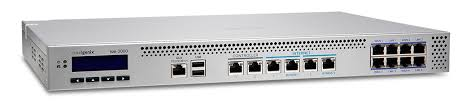
-C5G-WWvariants as the documented replacement; if you're planning a deployment now, confirm current orderability directly with Palo Alto before speccing these.📷 PaloAlto hardware lineup — ION device family
Virtual (Software) ION
The same ION software runs as a virtual appliance on:
- Public cloud: AWS, Azure, GCP, OCI, Alibaba Cloud
- On-premises virtualisation: VMware, KVM (NFV)
- Managed edge: Megaport Virtual Edge, Dell PowerEdge
Virtual ION is used where rack space is unavailable, for cloud-based branch/DC presence, or for NFV-based deployments in carrier environments.
Verified 2026-07-09 — this platform list confirmed still current and complete; no platforms added or deprecated since this chapter was written.
Operating Modes
| Mode | What it Does |
|---|---|
| Analytics Mode | Collects and reports traffic details, application performance, and path metrics — no active path enforcement |
| Control Mode | Enforces path selection, QoS, and application steering policies — full SD-WAN functionality |
Devices can be deployed initially in Analytics Mode to baseline traffic before switching to Control Mode to enforce policy.
Branch High-Availability Design
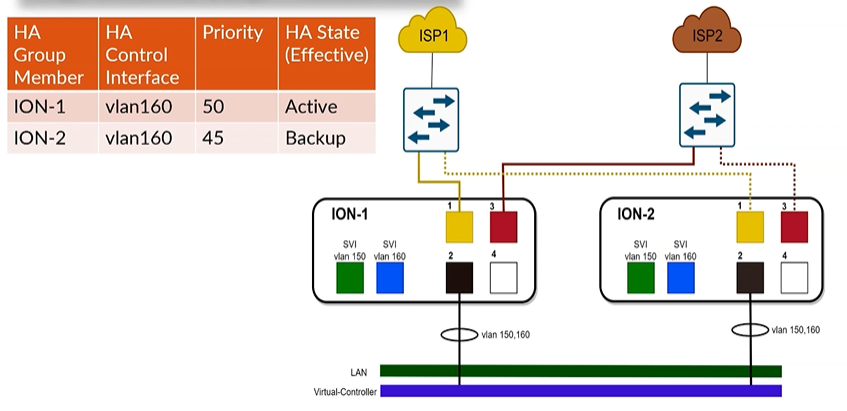
HA protects against ION device failure (software, hardware, or network) by pairing two ION devices at a branch site.
HA Topology
graph TD
    WAN1["WAN Link 1<br/>(MPLS / Broadband)"]
    WAN2["WAN Link 2<br/>(Broadband / LTE)"]
    ION_A["ION Active<br/>(Priority: high)"]
    ION_B["ION Backup<br/>(Priority: low)"]
    HA_LINK["HA Control Link<br/>(state sync)"]
    LAN["🏬 Branch LAN"]

    WAN1 --> ION_A
    WAN2 --> ION_A
    ION_A <--> HA_LINK <--> ION_B
    ION_A --> LAN
    ION_B -.->|bridges to active| ION_A
Constraints: - Maximum one HA group per branch site - Maximum two ION devices per HA group - One device is elected active; the other is backup
Verified 2026-07-09 — both constraints confirmed still current via direct fetch, quoted verbatim: "At most, one HA group may be created per branch site and up to two devices can be bound to a group."
Active vs Backup Responsibilities
| Function | Active Device | Backup Device |
|---|---|---|
| Traffic forwarding | Yes | Bridges to active only |
| Path selection (SD-WAN) | Yes | No |
| BGP peering | Yes | No |
| VPN establishment | Yes | Standby (unusable until failover) |
| Route advertising/learning | Yes | No |
| Statistics, alerts, alarms | Full | Limited |
The backup device bridges traffic to the active device — it does not independently perform path selection or BGP during normal operation. This ensures a single consistent set of forwarding decisions.
Election and Failover
- Priority assigned to each device determines which is elected active — higher priority = preferred active
- Recommended minimum priority gap between active and backup: 40 units — confirmed 2026-07-09 via direct fetch, quoted verbatim: "It is recommended to have a minimum difference of at least 40 between the priorities of an active ION device and a backup ION device"
- Preemption can be enabled — if a higher-priority device recovers, it reclaims the active role
- Failover triggers: software fault, hardware fault, WAN link failure, loss of required paths
HA Control Interface
- Synchronises state between active and backup (e.g. DHCP leases, session tables)
- Any Layer 3 interface with a static IP can serve as the HA control interface
- Recommended: use the dedicated Controller port when both devices share the same subnet
Key Takeaways
- Corrected 2026-07-09 — ION hardware ranges from small-branch to carrier-grade DC, but the lineup is not uniformly current: ION 1000, 2000, 3000, 7000, and 9000 are all confirmed end-of-sale (ION 7000 since 2022); only ION 1200/1200-S (current but ending sale Sept 2026), 3200/3200H, 5200, and 9200 are fully current for new deployments — confirm current orderability directly with Palo Alto before speccing
- Virtual ION platform list (AWS, Azure, GCP, OCI, Alibaba, VMware, KVM, Megaport Virtual Edge, Dell PowerEdge) confirmed still current and complete, 2026-07-09
- Analytics Mode for traffic baselining; Control Mode for active SD-WAN policy enforcement
- Branch HA: one group per site, two devices maximum; one active, one backup — both constraints confirmed still current 2026-07-09
- Active device owns all path selection, BGP, and VPN; backup bridges traffic only until failover
- Priority gap of 40+ between active and backup is recommended (confirmed still current 2026-07-09); preemption is configurable
Previous: Chapter 16 — SD-WAN Controllers, ION Communication & Trust Chain · Next: Chapter 18 — SD-WAN Design Considerations